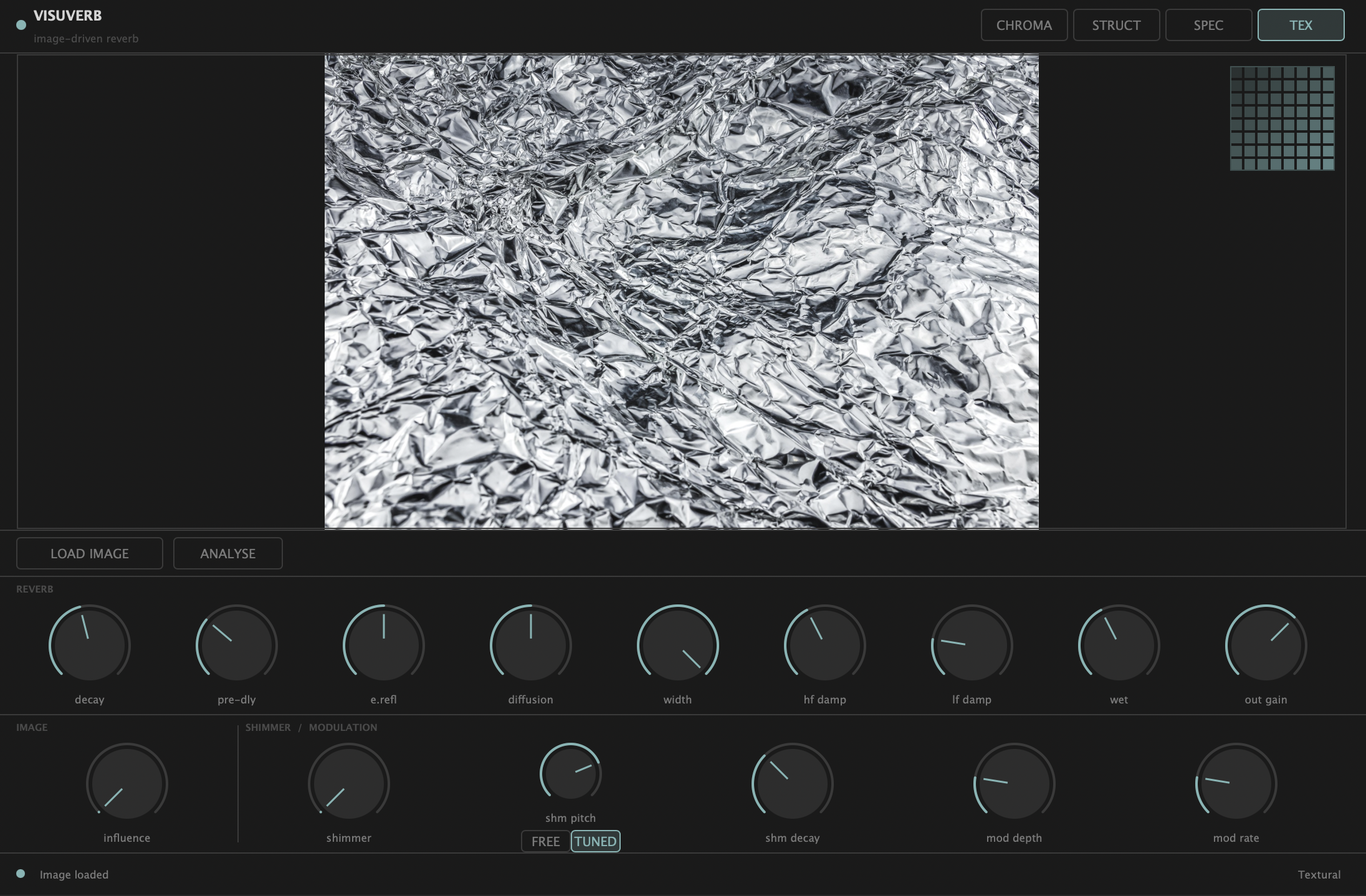
Load any image. Let its luminance, edges, color temperature, or texture drive the parameters of an 8-channel feedback delay network. Four analysis modes, one continuous reverb engine — infinitely variable without preset menus.
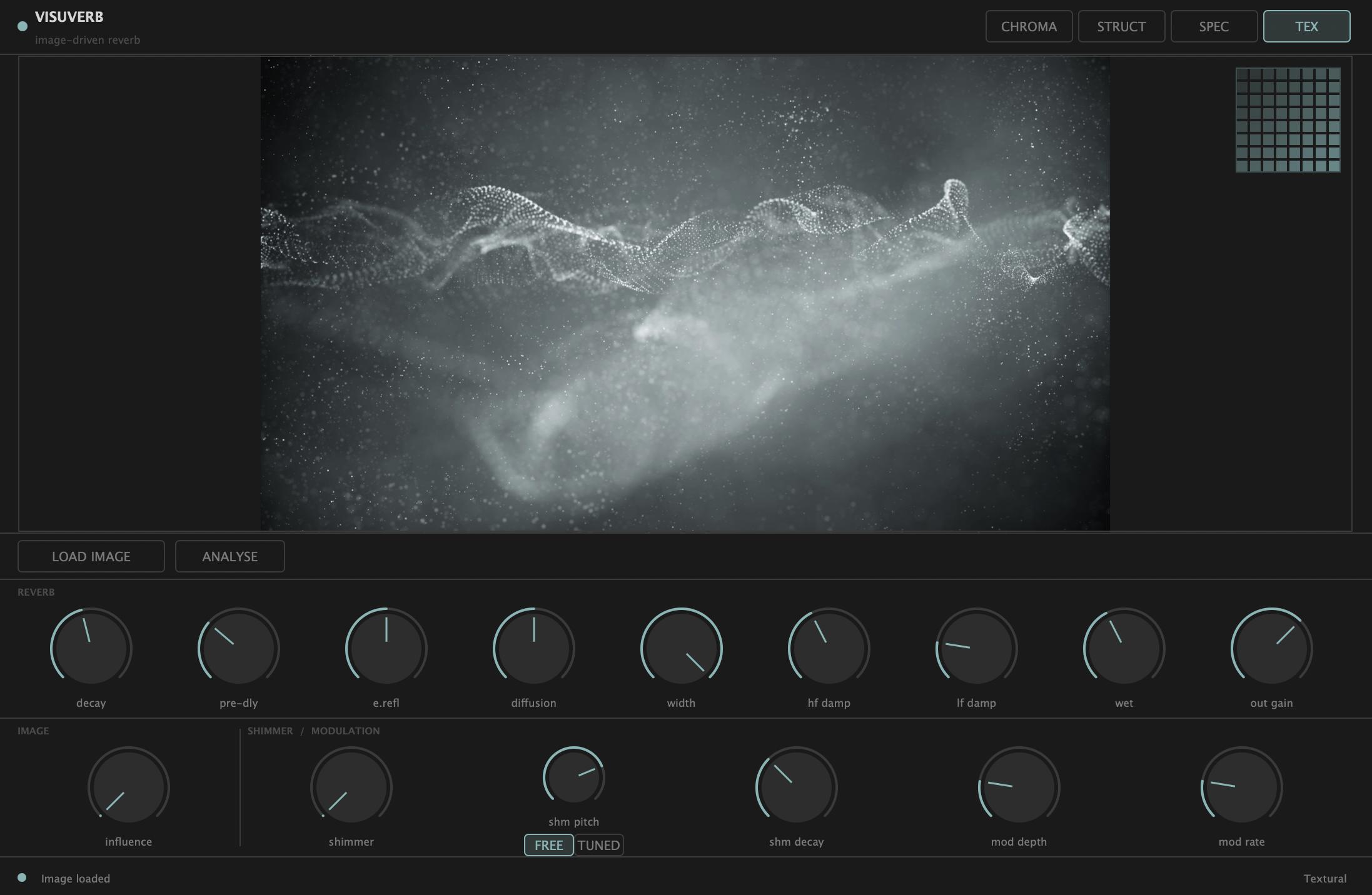
Visuverb with a photograph loaded — Textural mode.

Visuverb treats any image as a data source for reverb design. A photograph of a cathedral, an abstract painting, a spectrogram screenshot — each produces a unique constellation of delay times, damping curves, and feedback topology that would be nearly impossible to reach by hand.
Drag and drop any image file onto the plugin window, or use the Load Image button. JPEG, PNG, and most common formats are supported.
Select from four distinct algorithms — each reads the image differently and maps its features to different reverb properties.
The Image Influence knob crossfades continuously between your manual knob settings and the image-derived parameters. You're always in control.
Visuverb uses a single 8-channel FDN reverb engine at all times. CPU usage stays constant and the reverb tail never cuts out or crossfades. The image only modifies how the engine is parametrized.
Each mode extracts fundamentally different information — the same image sounds different in every mode.
Reads the luminance histogram of the image. Brightness, contrast, tonal skew, and overall entropy map to core reverb character.
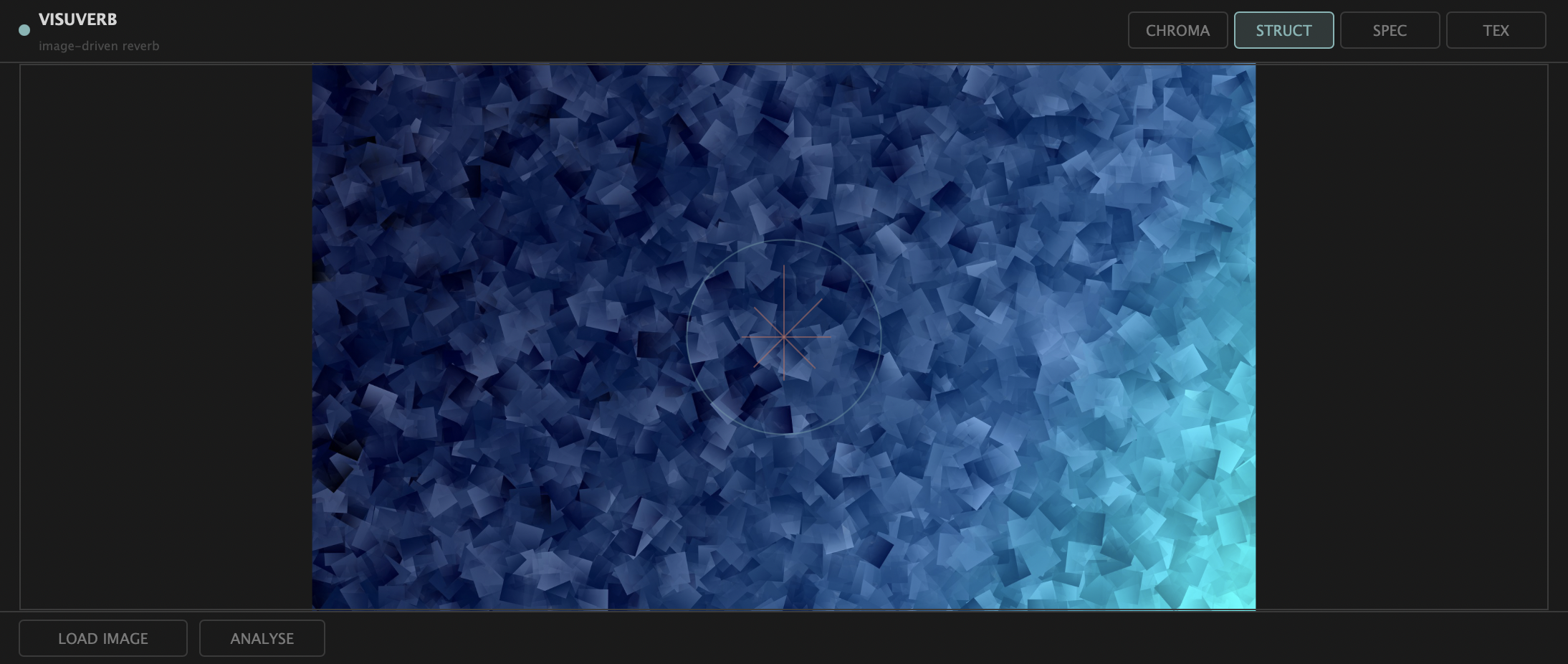
Applies Sobel edge detection to extract the image's geometry. Edge density and distribution shape the density and character of early reflections.
K-means++ clustering in CIE Lab colorspace groups the image's color temperature into four dominant clusters, mapping warm vs. cool tones to damping character.
Performs 8×8 DCT on every tile of the image, accumulates AC frequency magnitudes, then synthesizes a unique impulse response via IFFT. Every image produces a different IR.
The mode selector in the plugin header — switch modes in one click. Analysis must be re-run after switching.
Textural mode — analysis complete, IR loaded into convolution engine. The status bar shows the active mode name.
Textural is the only mode that replaces the FDN's reverb tail with a convolution-based IR synthesized from the image. The FDN's pre-delay and diffusion stages still run, giving you texture from the image and spatial control from the knobs simultaneously.
Prime-adjacent delay times. Hadamard mixing matrix. Per-line damping, modulation, and feedback gain.
Row 1 — the nine core reverb controls.
Eight delay lines run in parallel, each tuned to a prime-adjacent millisecond value (23, 29, 37, 41, 53, 61, 71, 79 ms). Each sample, every line is read, passed through HF and LF damping filters, mixed through an 8×8 Hadamard matrix, multiplied by per-line feedback gain computed from the RT60 formula, and written back with modulation applied.
When Image Influence is above zero, the delay times, per-line gain weights, and feedback matrix are all pulled toward image-derived values — smoothly interpolated block by block using a 512-sample crossfade to prevent clicks.
All controls smooth to prevent clicks on rapid changes. Image Influence can push any of these values from the image-derived side.
Controls the RT60 of the reverb tail. Short values give a tight room feel; long values open into infinite bloom. Internally mapped to per-line feedback gain via the decay formula.
Delay before audio enters the FDN. Creates separation between the dry signal and the first reflection, adding perceived room size without lengthening the tail.
Blends the output of the four allpass diffusers (early reflections) against the FDN's diffuse tail. Higher values add initial texture and density to the attack of the reverb.
Allpass filter coefficient (0.4 – 0.75 range). Higher diffusion scatters energy more evenly, smoothing the reverb onset. Lower values let individual early echoes be audible.
Controls stereo separation of the output. At 100%, even-indexed delay lines sum to the left channel and odd-indexed lines sum to the right. At 0%, output collapses to mono.
One-pole lowpass filter applied in the FDN feedback path. Higher values progressively roll off high frequencies with each loop, producing a darker and more natural-sounding decay.
Controls low-frequency damping in the feedback path. Higher values reduce bass energy with each loop, tightening the low end. Useful for preventing muddy buildup in dense mixes.
Final blend between the processed (wet) reverb signal and the original (dry) input. The dry signal is preserved in a separate buffer and never passes through the FDN.
Makeup gain applied after the soft limiter. The built-in limiter (threshold 0.9, 150 ms release) prevents clipping even at extreme settings, so Output Gain is safe to push.
The Image Influence knob is a continuous blend between two states: your manual knob positions (at 0%) and the parameter set derived from the image analysis (at 100%). At any position in between, each reverb parameter is linearly interpolated.
This means you can use the image as a starting point and then fine-tune manually, or use your manual knobs as an anchor and let the image nudge the character. The knobs always define one endpoint of the blend.
To prevent images from pushing the reverb into an unusable state, analysis results can lower HF or LF damping freely, but cannot raise them more than 15% above your current knob values. This preserves the reverb's tail at high influence settings.
Drag any image file directly onto the plugin window, or click Load Image. After loading, click Analyse to run the analysis for the currently selected mode. If you switch modes, you need to click Analyse again — each mode produces different results from the same image.
The image display zone — drag and drop any image here, or use Load Image.
A phase-vocoder pitch shifter runs in the FDN feedback path, creating the shimmer effect without time drift or instability.
The shimmer controls — Amount, Pitch (semitones), Decay multiplier, and Harmonic Lock toggle.
The shimmer processor uses a streaming STFT phase vocoder (Bernsee/DAFX method): overlapping 2048-point Hann-windowed frames (4× oversample, 75% overlap) are FFT'd, each bin's true instantaneous frequency is estimated from inter-frame phase differences, spectral bins are remapped by the pitch ratio, and a phase-coherent spectrum is resynthesised via IFFT and windowed overlap-add. Because analysis hop equals synthesis hop, output length always matches input — shimmer can sustain indefinitely at any pitch without time drift. On a sustained reverb tail the phase vocoder's only weakness (transient smearing) never shows, so the result is smooth and artefact-free.
Wet level of the pitch-shifted signal injected into the FDN. Internally capped at 55% to prevent feedback instability. At 100% control position, the shimmer blooms noticeably but stays stable.
Pitch-shift amount in semitones. +12 = octave up (classic shimmer). −12 = octave down for a darker bloom. Any value produces a valid effect; Harmonic Lock can constrain it to musical intervals.
Multiplier applied to the RT60 feedback gain for the shimmer path. Above 1.0, the shimmer bloom extends longer than the dry tail. Below 1.0, it fades faster. Values above 1.5 produce very long spatial effects.
When TUNED, quantizes the shimmer pitch to the nearest allowed musical interval regardless of the Pitch knob position. When FREE, uses the exact knob value. See intervals below.
When Harmonic Lock is enabled, the pitch snaps to one of these musically consonant intervals:
Each of the eight FDN delay lines has an independent LFO modulating its effective length. The LFOs share the same rate and depth, but are offset in phase by equal steps around the full cycle — this distributes the modulation energy evenly and prevents audible beating between lines.
At low rates (0.1 – 0.5 Hz) and moderate depth, the effect is a slow, organic chorus-like breathiness. Raising the rate into the 1–5 Hz range adds a classic pitch-modulated quality. Above 5 Hz, flanging effects emerge as the delay time variation becomes perceptible as a pitch wobble.
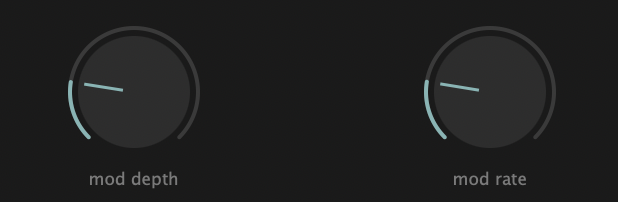
Amplitude of the LFO applied to each delay line. At 100%, delay time variation is ±0.5% of the base delay. Larger depth = wider, more pronounced modulation.
LFO frequency. Exponentially scaled so fine control is available in the sub-1 Hz range. Low rates work best for ambient pads; higher rates suit rhythmic material or special effects.
Mod Depth and Mod Rate — the two modulation controls.
Five steps from installation to your first image-driven reverb.
Install the plugin format appropriate for your OS and DAW (VST3 or AU). Once installed, rescan in your DAW and insert Visuverb on any stereo or mono track as a send or insert effect.
Before touching the image controls, set a baseline reverb using the nine core knobs. Dial in Decay Time, HF Damping, Diffusion, and Wet/Dry to your preference. This becomes the "0% influence" state — the anchor your image will blend from.
Drag and drop any image file directly onto the plugin's image zone, or click the LOAD IMAGE button and browse. The image is displayed in the plugin window immediately. JPEG and PNG are recommended.
Select an analysis mode using the mode selector in the header (Chromatic, Structural, Spectral, or Textural). Then click ANALYSE. A progress indicator appears in the status bar. Analysis typically completes in under a second for most images.
Turn up the Image Influence knob (in Row 2 of controls) from 0% toward 100%. The reverb character smoothly transitions toward the image-derived parameters. Automate this knob for dynamic, evolving reverb that changes with your arrangement.
| Format | VST3 / AU |
| Platform | macOS / Windows |
| Audio I/O | Stereo (2 in / 2 out) |
| Tail Length | 20 seconds |
| Latency (VST3 / AU) | Zero (non-Textural modes) |
| CPU (44.1 kHz / 512) | < 5% (typical) |
| Parameters | 17 (16 automation-ready) |
| Analysis Thread | Background (non-blocking) |
All 17 parameters — ranges, defaults, and descriptions.
| Parameter | Range | Default | Unit | Description |
|---|---|---|---|---|
| Decay Time image | 0.1 – 60.0 | 2.5 | seconds | RT60 of the reverb tail. Internally converts to per-line feedback gain via the decay formula. Smoothed over 50 ms. |
| Pre-Delay image | 0 – 200 | 20 | ms | Delay before audio enters the FDN. Stereo buffer, linear interpolation. Creates perceived room size. |
| Early Refl Mix | 0 – 100 | 50 | % | Balance between allpass diffuser output (early reflections) and the late diffuse FDN tail. |
| Diffusion image | 0 – 100 | 50 | % | Allpass coefficient (0.4 + value × 0.35). Higher = smoother onset; lower = audible individual echoes. Smoothed 20 ms. |
| Stereo Width image | 0 – 100 | 100 | % | Separation between even-indexed (L) and odd-indexed (R) delay lines. 0% = mono collapse. Smoothed 10 ms. |
| HF Damping image | 0 – 100 | 40 | % | One-pole lowpass in feedback path. Higher = darker tail. Image cannot raise this more than 15% above knob value. Smoothed 10 ms. |
| LF Damping image | 0 – 100 | 20 | % | One-pole highpass in feedback path. Higher = less bass rumble. Same damping-cap rule as HF Damping. Smoothed 10 ms. |
| Wet / Dry Mix | 0 – 100 | 40 | % | Final blend between processed reverb output and original dry signal. Dry path is a separate buffer, not affected by FDN. Smoothed 10 ms. |
| Output Gain | −24 to +12 | 0 | dB | Makeup gain after the soft limiter. Safe to use aggressively — the 0.9-threshold limiter prevents clipping at the output stage. Smoothed 10 ms. |
| Parameter | Range | Default | Unit | Description |
|---|---|---|---|---|
| Image Influence | 0 – 100 | 0 | % | Blend between manual knob values (0%) and image-derived parameter set (100%). Linear interpolation per parameter per block. |
| Analysis Mode | 0 – 3 | 0 | choice | Selects the image analysis algorithm: 0 = Chromatic, 1 = Structural, 2 = Spectral, 3 = Textural. Switching mode requires a new Analyse run. |
| Parameter | Range | Default | Unit | Description |
|---|---|---|---|---|
| Shimmer Amount | 0 – 100 | 0 | % | Wet level of pitch-shifted signal in FDN feedback. Internally capped at 55% to prevent instability. Smoothed 30 ms. |
| Shimmer Pitch | −24 to +24 | +12 | semitones | Pitch-shift amount. In TUNED mode, quantized to nearest allowed interval. Any value valid in FREE mode. |
| Shimmer Decay | 0.5 – 2.0 | 1.0 | × multiplier | RT60 gain multiplier for shimmer feedback path. >1.0 extends shimmer longer than the dry reverb tail. |
| Harmonic Lock | FREE / TUNED | FREE | toggle | TUNED mode quantizes shimmer pitch to musically consonant intervals: ±24, ±19, ±17, ±12, ±7, ±5, 0 semitones. |
| Parameter | Range | Default | Unit | Description |
|---|---|---|---|---|
| Mod Depth | 0 – 100 | 20 | % | LFO amplitude applied to each delay line. Maximum ±0.5% of base delay time. Eight independent LFOs share this depth. Smoothed 20 ms. |
| Mod Rate | 0.1 – 10.0 | 0.5 | Hz | LFO frequency. Exponential scale favors sub-1 Hz range. Each delay line's LFO is phase-staggered by 1/8 of the full cycle. Smoothed 50 ms. |
image Parameters marked with this badge can be pushed by Image Influence toward image-derived values when Influence > 0%.